
I’ve been staring at the words “THE END” for three days now, barely believing they’re actually there. After eleven months of false starts, midnight writing sessions, and more self-doubt than any reasonable person should endure, I’ve somehow managed to finish my second book.
Polished Edges is done. Well, the first draft is done, which in the writing world is roughly equivalent to having assembled all the pieces of a complicated puzzle whilst blindfolded. Now comes the terrifying part: showing it to other people.
Last year’s Between Languages explored immigrant identity and cultural displacement through four interconnected stories. That collection taught me how to write, gave me permission to trust my observations. But this project feels different. More ambitious. More exposing.
The idea crystallised during one of those long afternoons in my studio, watching a client’s hands as I applied the final coat of “Russian Roulette”, a colour that looked like spilled secrets. She was telling me about her ex-husband’s new girlfriend whilst I carefully painted each nail, and I suddenly realised I was holding more than just her fingers. I was holding her story.
That’s when it hit me: I spend my days literally in touch with people’s most vulnerable moments. They trust me with their hands, their time, their confessions. For an hour, they’re captive in my chair, and something about the ritual of being cared for opens them up in ways they probably don’t even realise.
The protagonist isn’t exactly me, but she’s definitely my cousin. A nail artist who collects secrets the way other people collect vintage handbags, carefully, obsessively, with growing awareness of the responsibility that comes with each acquisition. She becomes an accidental anthropologist of affluent anxiety, documenting the gap between public personas and private pain.
Each story focuses on a different client, a different shade, a different crack in the carefully constructed façade. The TikTok dancer whose neon coral hides algorithmic burnout. The diplomat whose nude gel conceals geopolitical compromises. The ballerina who chooses midnight black to mask impossible choices.
I spent months getting the balance right, sharp enough to cut through pretence, but compassionate enough to honour the real human hurt underneath. These aren’t just satirical sketches of wealthy people; they’re excavations of what happens when the pressure to appear perfect becomes literally unbearable.
Here’s a tiny taste, from the story about a fashion week regular:
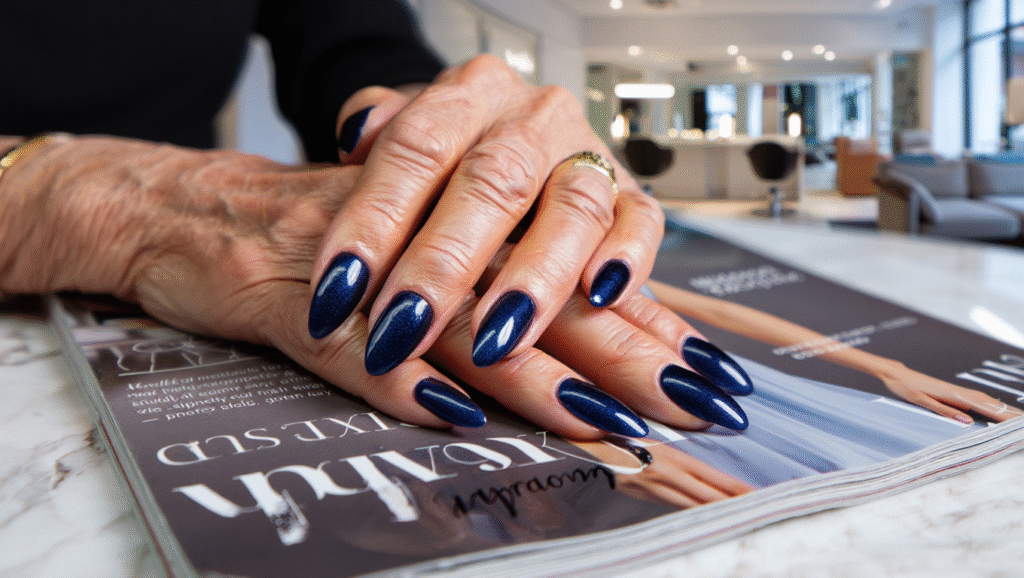
“Cassidy Jones, senior fashion correspondent for a glossy New York magazine that set global trends, always flew in for Fashion Week with an air of exhausted glamour and an unshakeable belief in her own importance. Her nails were her trademark: long, stiletto-sharp, and always painted in ‘Midnight Bloom,’ a dark, almost black indigo with a subtle ‘cat-eye’ magnetic shimmer that shifted with her every imperious gesture. It was the colour of inside knowledge, of late-night secrets, of power held just out of sight.”
Publishing this feels like performing surgery on yourself in public. Every story contains pieces of real conversations, real observations, real people who trusted me with their vulnerabilities. I’ve changed names, details, circumstances, but the emotional truth remains intact.
The collection explores what happens when your job requires you to witness other people’s humanity on a daily basis. How do you maintain professional boundaries whilst remaining genuinely empathetic? How do you honour the stories people give you without exploiting them?
My protagonist wrestles with these questions throughout the sixteen stories, gradually evolving from detached observer to reluctant participant in the lives she’s documenting. By the final piece, she’s forced to confront her own polished edges, the ways she’s been using other people’s stories to avoid examining her own.
Between Languages explored these questions through immigrant experiences, through people navigating cultural displacement. Polished Edges asks the same questions in a more glamorous context, but the themes persist: performance, authenticity, the gap between who we are and who we present.
I won’t lie: I’m terrified. Publishing a second book feels more vulnerable than the first. The immigrant stories felt safely distant, drawn from memories and observations of others. This one is drawn from my daily life, from people who might recognise themselves, from a world I still inhabit professionally.
But I’m also exhilarated. I’ve created something that exists entirely because I believed it should exist. Not because market research suggested demand, not because it filled a gap in my professional portfolio, but because I had stories that needed telling.
The manuscript is currently with a few trusted readers, people whose opinions I value and whose honesty I can handle. Depending on their feedback, I’ll spend the next few months revising, polishing, and trying not to lose my nerve entirely.
If all goes well, Polished Edges will see daylight sometime in spring 2022. Until then, I’m back to the daily routine of nail appointments and story collection, watching my clients’ hands and wondering what new secrets they might reveal.
Posted from my studio, where every manicure is a potential story and every story is a small act of courage.
— Writer Julia Zolotova
