
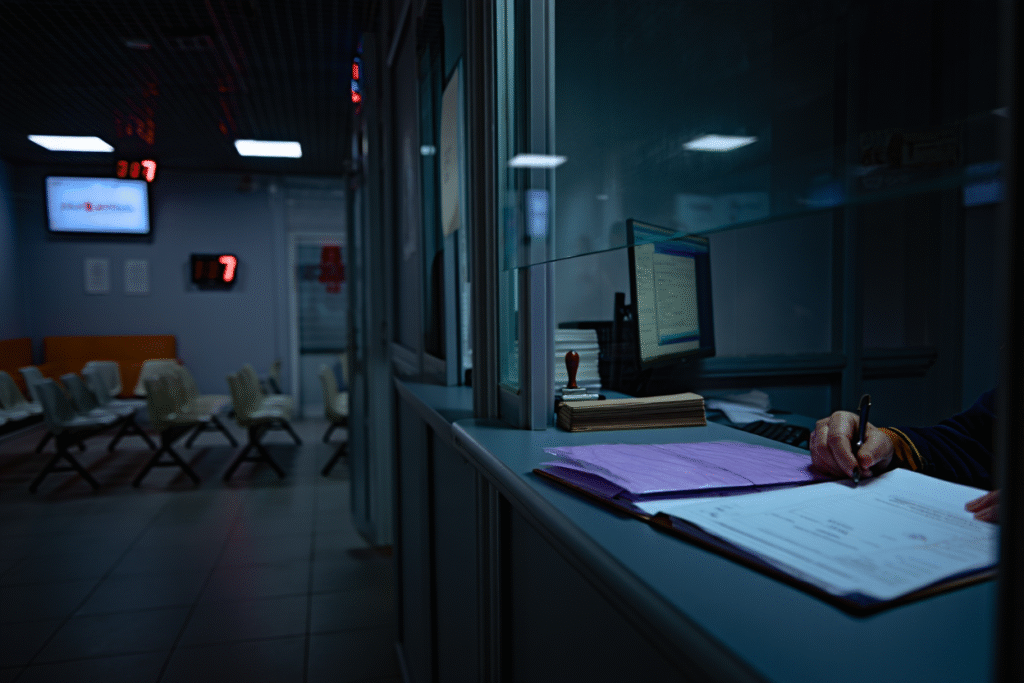
My second story is about Oksana, a translator at a visa centre who must choose between accurate translation and human compassion.
I wrote this after conversations with friends who work as interpreters, who described the impossible position of being simultaneously invisible and all-powerful. The responsibility of choosing which truths to translate and how.
Oksana’s chair squeaked as she shifted behind the counter at Window No. 7. The visa centre’s waiting hall was harshly lit and nearly empty near closing time. Outside her booth’s glass, a digital ticker blinked 7, summoning the next applicant. A young woman approached, clutching a frayed purple folder. She had a cautious step, as if ready to bolt. Oksana mustered a reassuring smile, the one she saved for particularly anxious visitors.
“Добрый день,” came the low rumble of the case officer seated beside Oksana, a stern man in a crisp uniform. Good day. He barely glanced up from the screen. Oksana cleared her throat and translated the greeting into English. The woman gave a quick, jerky nod. Up close, she looked about Oksana’s age, mid-twenties, but her eyes were ringed with exhaustion. A faded bruise peeked out from the edge of her headscarf.
The officer started briskly in Russian, “Purpose of visit extension?” Oksana rendered it in English as gently as possible: “He’s asking why you need to extend your stay.”
The woman opened her folder with trembling fingers. “I… I am a student,” she began softly. Her accent lilted—a hint of Arabic. “My studies at the language academy ended, but I cannot go back home now.” She slid forward a certificate of enrollment and a passport. Oksana saw the passport’s cover: Syrian Arab Republic. Her heart clenched. Syria.
Her screen flashed that the visa had expired a week ago—a violation that normally meant denial. Oksana swallowed; the rules were black-and-white. Just yesterday, she had seen a colleague turn away an applicant for filing two days late, muttering “Правила есть правила” (rules are rules) with a shrug. She’d gone home haunted by the look on that man’s face.
Now she looked at this woman, who was staring down at her documents as if they might shield her. “Tell him…” the woman’s voice broke the silence, “tell him I cannot return to my town. My father…” She took a breath and continued in a rush, “My father has promised me in marriage to a much older man. If I go back now, the wedding will be immediate. I–” her voice faltered. “I won’t be safe.”
Oksana felt a prickle at the back of her neck. She glanced at the officer reading the paperwork. His expression was impassive. He hadn’t understood the woman’s English, but soon he would expect Oksana’s translation. She thought of the pledge all interpreters were taught: translate everything accurately — add nothing, omit nothing, change nothing. And she thought of her colleague’s refrain: rules are rules.
“She says her studies have finished,” Oksana began in Russian, her voice steady, “and her home region is experiencing unrest. She fears for her safety if she returns right now.” It wasn’t a lie, not exactly—just not the whole truth. The officer raised an eyebrow.
“Unrest?” he repeated, peering at the Syrian passport. “Есть какие-то документы, подтверждающие это? Any documents to confirm?”
Oksana relayed the question in English. The woman bit her lip and whispered, “No. Only the news… You know what is happening in Syria. I have nothing official.”
No official proof. The officer leaned back, crossing his arms. In Russian, he muttered, “Without documentation, no basis for extension beyond the standard period.” He nodded at Oksana to translate his verdict.
Oksana’s throat tightened. She looked at the woman’s clenched hands, knuckles white against the purple folder. “He says…” she began slowly in English, meeting the woman’s eyes. She saw tears brimming and a quiet plea in them. In that moment, Oksana decided. “He says there is a lot of paperwork,” she continued gently, “but we will do our best to help you.”
The officer shot her a sharp look; that was not what he’d said. Oksana pretended not to notice and turned back to him. In Russian, she spoke with calm confidence, “Она говорит, что была задержка из-за карантина, поэтому документы не готовы.” A small lie: she claims a quarantine delay kept her from getting the papers. It invoked the all-too-familiar COVID excuse that supervisors had told them to accept leniently this year. The officer frowned, but slowly nodded for her to continue.
He tapped the screen and spoke again. “Standard extension is one month. After that, deportation if no valid status. Understood?” Oksana translated this to English faithfully. The woman breathed out a yes, relief and dread mingling on her face. One month was something, a precious reprieve.
The officer began typing up notes. He stamped a form with a heavy thud and slid it toward Oksana to collect the woman’s signature. “Tell her to report any address change and to carry this at all times,” he added.
As Oksana interpreted the instructions, the woman managed a small, shaky smile for the first time. She signed the form. When Oksana returned the papers, the woman covered Oksana’s hand briefly with her own. “Thank you,” she whispered in English, eyes full. Oksana just nodded, not trusting herself to speak.
Moments later, the printer whirred and spat out an official extension notice. Oksana picked it up and stepped around the counter to hand it over. The woman bowed her head in gratitude, accepting the document as if it were a lifeline. In halting Russian, she said, “Спасибо. Большое спасибо.” Thank you. Thank you very much.
The officer had already begun packing his briefcase, indifferent. The woman turned to leave, but before she reached the door, Oksana gently touched her arm. In English, she murmured, “Good luck.” It was a simple benediction, offered with a kind smile.
As the woman disappeared down the dim corridor toward the winter dusk, Oksana sank back into her chair. Her heart was fluttering, but a quiet exhilaration warmed her. Through the smeared booth glass, she could just make out the woman’s form departing into the evening. Maybe no one would ever know how a few careful words had bent the rules today. But as she powered down her computer and the overhead lights clicked off, Oksana felt something shift inside her. Sometimes человечность — common humanity — mattered more than protocol. In that small moment at Window No. 7, she had chosen to be not just a translator of languages, but of hopes and needs as well. She gathered her coat, whispering “Слава богу” under her breath – thank God – and stepped out into the cold Moscow night.
Translation work fascinates me because it’s such a perfect metaphor for the choices we make about what to reveal and what to obscure. Oksana’s decision is about more than language. It’s about recognising when the system itself is the problem, and choosing humanity over protocol.
These stories are teaching me how to write. Each one reveals something new about structure, voice, the balance between showing and telling.
Meanwhile, the longer project about the beauty industry continues to grow. Different material, but the same fundamental questions about performance and authenticity.
Posted from London, where every conversation involves translation, even when we speak the same language.
— Writer Julia Zolotova
