
I’ve written my first short story.
This wasn’t planned. I’ve been carrying around a notebook for years, filling it with observations from my nail work and marketing job, never quite sure what to do with all these fragments. Then last week, sitting in a café near campus, I started writing about Nadya, a Russian student in Beijing who discovers that a different name can mean a different self.
The story poured out in one sitting. I wrote it thinking about my own time studying in China, about how displacement sometimes gives us permission to become who we actually are.
I’m not sure what to do with this yet. It feels too personal to share widely, but also too complete to leave in a drawer. Maybe this is just an experiment. Maybe it’s the beginning of something.
For now, here’s Nadya’s story.
Nadya first heard it spoken on a rain-slick street in Beijing: her new name, bright and round in the mouth of a friend. “Lina, záogāo!” a classmate laughed as she dashed across puddles, the Chinese exclamation for “what a mess” bright in her tone. Lina – two gentle syllables, pronounced the same as Лина in Russian – felt entirely different. Written in pinyin letters on her phone screen, it looked like a small freedom. Lina was a girl who could slip through the city unnoticed, unburdened by the expectations that clung to “Nadezhda”—her full Russian name, heavy with centuries of meaning: hope (надежда). Here she was simply Lina, one name among many on the class WeChat group.
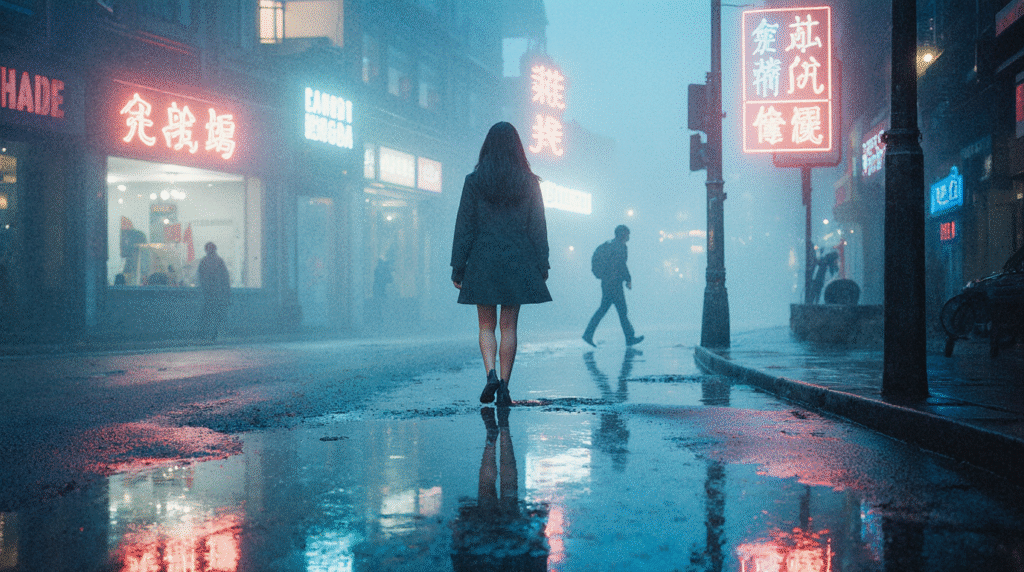
Beijing hummed around her, a vast symphony of car horns and bicycle bells. In the evenings, neon characters reflected off wet pavement and onto her skin, making her feel like a character in a story. At the corner noodle stall near campus, the laoban always greeted her with a nod and a hearty “привет” – he had learned to say hello in Russian for her. She responded with a shy “nǐ hǎo” (你好) in return, blending into the chorus of Mandarin around them. These small exchanges warmed her; each day, her fear of speaking up melted a little more into the steam rising from her bowl of dāoxiāomiàn. Lina, unlike Nadezhda, was not afraid of making mistakes in Chinese. She could laugh off mispronunciations and try again, treating each interaction as practice rather than a test of character.
She still called home every Sunday. One grey October night, Nadya cradled her phone and listened to Mama’s familiar voice from 5,000 kilometers away. “Дочка, как дела?” her mother asked gently – How are you, dear? Nadya hesitated. Should she tell her about Lina? About how, in this sprawling city where nobody knew her past, she sometimes felt more herself than ever? Instead she answered in Russian, reassuring her mother that everything is fine. She described the university library and the ancient ginkgo trees on campus turning golden in the autumn air. She left out the part about staying out late with friends from four different countries, all of them shouting each other’s names under the blinking lights of a KTV bar. When her mother said Пока, спокойной ночи (Bye, good night), Nadya replied with a soft “Спокойной ночи, мама,” and hung up, the Russian words lingering in the silence of her dorm room.
It was Lina who stayed out past curfew last Thursday, huddled on the back of a scooter as her friend Meilin navigated narrow hutong alleys. They raced to catch the midnight snack stall before it closed, their laughter trailing like ribbons in the wind. Under the red lantern glow, Lina slurped long strands of liangpi noodles slicked with chili oil, not minding the spice that made her eyes water. If it had been Nadezhda, she might have worried about looking messy or improper. But Lina fanned her burning tongue and exclaimed “Ничего себе!” (Wow!), which sent Meilin into giggles. Delighted, her friend made Lina teach her more funny Russian exclamations. They swapped words back and forth, sharing pieces of their native languages like trading candies.
As midterms loomed, Lina found herself volunteering to organize a study group. She even agreed to host it in her tiny dorm lounge. On the night of, balancing mugs of jasmine tea, she realized halfway through explaining a grammar pattern that she was speaking more freely than she ever had back home. The words came out fluidly in Mandarin, with only a slight accent, as her peers listened. She remembered how in Moscow she often shrank from raising her hand, afraid of getting something wrong. But in this circle of international students, laughter and mistakes mingled with understanding. If she stumbled on a word, she just shrugged and searched for another way to say it. One of the Chinese students, clapping in appreciation after Nadya improvised a clever mnemonic, told her earnestly, “Nǐ hěn qiáng!” (您很强) – You are very strong! The praise in that language felt different, landing deeper in her chest.
Later that week, Lina sat by her dorm window overlooking the campus pond. A group of first-year students were practicing their evening dance routine on the basketball court below, moving in unison to a tinny pop song. She remembered how, at first, she’d felt like an outsider watching life in Beijing swirl around her. Now, more than a year into her studies, the city had woven her into its fabric with a nickname and countless shared meals, late-night chats, and study sessions. She pressed her forehead to the cool glass and whispered, “Спасибо” — thank you in Russian — to no one in particular. Thank you for this chance to be someone new, or perhaps to become more herself than ever. In the reflection on the glass, she saw a young woman with bright, curious eyes and wondered if that was Lina or Nadya looking back.
In the end, she decided, they were the same. Lina was just a version of Nadezhda who had been given permission to bloom on her own terms. Beijing — with its neon nights and early morning tai chi in the parks, with its mix of títǒng pandemic warnings and warm calls of “Chī le ma?” (Have you eaten?) from neighbors — had taught her that a name could be a bridge to a new self. On her last day before winter break, she signed off an email to a favorite professor with both names: “Nadezhda (Lina).” It felt right to claim them both. Outside, the first snow of the season drifted down onto the ancient campus pines. In that quiet moment, far from home but wholly herself, Nadya closed her eyes and savored the gentle duality of her life: one woman, two names, and an open future written in both Russian and Chinese characters.
Writing fiction feels different from everything else I’ve done. Not better or worse, just truer somehow. Like I’ve finally found the right language for observations that never quite fit into marketing reports or casual conversation.
I don’t know if I’ll write another story. But I’m glad this one exists.
— Writer Julia Zolotova
